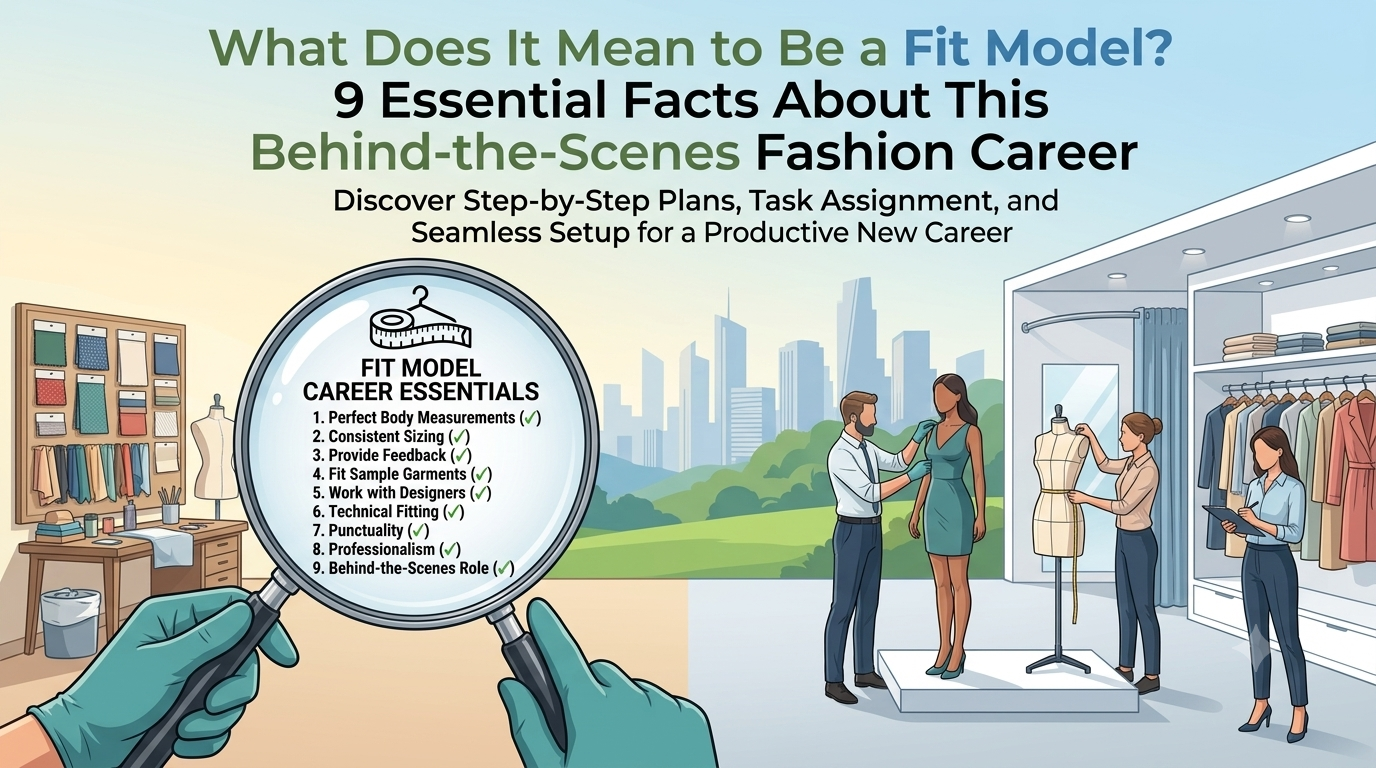
Most people picture fashion models walking runways, appearing in magazines, or starring in advertising campaigns. However, what does it mean to be a fit model is a question that highlights a different side of the fashion industry. For almost every perfectly-fitting clothing item, there is another professional whose efforts are usually overlooked, yet are integral to ensuring the clothes fit.Understanding what does it mean to be a fit model reveals an essential role in the fashion industry that has little to do with fame and everything to do with precision.
Understanding what does it mean to be a fit model starts with recognizing the important role these professionals play in clothing development. The live reference to the clothes designers, patternmakers and tech design teams is the fit model. Rather than modeling completed clothes to the end consumer, these fit models wear garments during development in order for brands to assess the drape, range of motion, feel and fit for production. Their consistent body measurements enable designers to perfect pattern making.
For anyone interested in fashion careers, garment production, or apparel design, understanding what does it mean to be a fit model provides valuable insight into how quality clothing is created while exploring other fashion industry career guides. You’ll be learning all about the work of fit models and what separates them from everyday fashion models. You’ll get insight into the necessary credentials needed for a fit model and the available careers in the clothing industry as well as why they’re so important!
Why Fit Models Matter More Than Most People Realize
As a consumer try on clothing, we all become aware of sleeves that are pulling tight, waistbands that are the correct rise or pant lengths that are perfect. Those things are never happenstance. They are actually often the result of numerous fitting sessions with a professional fit model.
All clothing companies create patterns for their garments based upon standard body measurements. Before a garment is available in stores, designers need to make sure the fabric lays properly, all seams will be aligned, and the fit is appropriate for standing, sitting, walking and moving.
Clothing can be well-made and well-designed, but if it hasn’t been properly fit tested, it will fail customers in the end.
Fit models are the link between flat paper patterns and clothes worn on the human body as they offer valuable body feedback that mannequins are not capable of providing.
What Does It Mean to Be a Fit Model?
Fit model Fit model Definition A fit model is someone hired by apparel and fashion labels to wear prototype apparel during product development. Generally, Their job is to assist a technical designer on determining the overall clothingfiton a human shape. Fit models differ from commercial, editorial, and even run waymodels.
This role depends largely on anindividual’sw measurement rather than theirlooks.
Companies search fit model who body measures line up precisely to the average shape for thatbrand size range.
During fittings, designers examine numerous factors, including:
- Overall garment balance
- Shoulder alignment
- Sleeve placement
- Waist positioning
- Ease of movement
- Fabric behavior
- Length adjustments
- Seam placement
- Comfort during motion
Because every adjustment affects future production, fit models contribute directly to clothing quality.
How Fit Modeling Differs From Traditional Modeling
The number one myths about fit model job – These girls do as much work as fashion models A frequent misinformation of people outside the fashion industry: fit and fashion model they do an equally important. Indeed, work of models belongs to clothes but this function for them different.
| Fit Model | Fashion Model |
| Helps improve garment fit | Promotes finished clothing |
| Works during product development | Works after production |
| Selected for consistent measurements | Selected for appearance and brand image |
| Gives fitting feedback | Presents finished designs |
| Usually works privately with design teams | Appears in advertising, catalogs, or runway shows |
A fit model may never appear in public marketing materials, yet their work influences every customer who eventually purchases the clothing.
How Designers Use Fit Models During Product Development
Garment creation involves much more than sketching ideas. After patterns are drafted and sample garments are sewn, designers schedule fitting sessions.
A typical fitting may include:
First Sample Evaluation
The initial garment is examined for major fitting issues such as incorrect proportions, seam placement, or silhouette.
Pattern Adjustments
Technical designers mark necessary changes directly on the garment while the fit model wears it.
Revised Samples
Updated garments are tested again to determine whether previous issues have been resolved.
Movement Testing
Fit models walk, sit, bend, stretch, and raise their arms so designers can observe how garments perform during everyday movement.
Production Approval
Once designers are satisfied, the garment moves toward manufacturing.
Some garments require multiple rounds of fittings before receiving final approval.
What Qualifications Does a Fit Model Need?
Success depends less on appearance than on consistency and professionalism.
Important qualifications include:
Consistent Body Measurements
Brands hire fit models whose measurements match specific size standards. Even small changes may affect employment because clothing is developed around precise dimensions.
Reliability
Fitting schedules often operate under tight production deadlines.
Body Awareness
Fit models should recognize areas where garments feel restrictive, loose, or uncomfortable.
Communication Skills
Designers rely on accurate feedback regarding garment comfort and movement.
Patience
Some fittings last several hours while multiple adjustments are made.
Professional Conduct
Working with designers, technical teams, and manufacturers requires punctuality, discretion, and professionalism.
Standard Measurements Matter More Than Height
Unlike runway modeling, height requirements are often flexible depending on the brand.
Instead, companies prioritize measurements such as:
- Bust
- Waist
- Hip
- Inseam
- Shoulder width
- Neck circumference
- Arm length
- Rise
- Thigh circumference
Each apparel company maintains its own measurement specifications for different product lines.
Types of Fit Models
Fit modeling includes several specialized categories.
Women’s Fit Models
Used by brands producing dresses, tops, jeans, athletic wear, lingerie, or business attire.
Men’s Fit Models
Assist with shirts, trousers, jackets, suits, uniforms, and sportswear.
Plus-Size Fit Models
Represent extended sizing collections.
Petite Fit Models
Help brands design clothing for shorter body proportions.
Tall Fit Models
Used for extended-length garments.
Children’s Fit Models
Assist manufacturers developing apparel for infants, children, and teenagers.
Activewear Fit Models
Evaluate garments designed for exercise, flexibility, and athletic performance.
What Happens During a Fit Session?
A fitting session is highly technical rather than glamorous.
The process generally includes:
- Measuring the garment
- Trying on sample clothing
- Standing in specific positions
- Walking naturally
- Sitting and bending
- Stretching where appropriate
- Receiving pin adjustments
- Discussing comfort with designers
- Recording technical notes
Designers often photograph garments from multiple angles to compare revisions over time, following professional garment fitting and apparel product development practices throughout the design process.
Why Communication Is an Essential Skill
Fit models do much more than simply wear clothing.
They describe observations such as:
- The waistband feels too tight when sitting.
- Sleeves restrict shoulder movement.
- The neckline shifts while walking.
- Fabric pulls across the hips.
- The collar sits too high.
Providing objective and detailed feedback helps designers identify and correct issues more effectively.
Industries That Hire Fit Models
Fit models work across many sectors, including:
- Fashion brands
- Sportswear manufacturers
- Outdoor clothing companies
- Uniform suppliers
- Luxury fashion houses
- Children’s apparel brands
- Denim manufacturers
- Swimwear companies
- Workwear manufacturers
- E-commerce clothing retailers
Nearly every apparel company developing original clothing relies on fitting evaluations.
Can You Build a Career as a Fit Model?
Yes. Many professionals work consistently with the same clothing companies for years.
Some fit models specialize in:
- Denim
- Athletic apparel
- Luxury fashion
- Medical uniforms
- Swimwear
- Plus-size fashion
- Children’s clothing
Experienced fit models become valuable because designers learn to trust their consistent feedback.
How Much Do Fit Models Earn?
Rates are dependent on experience, geographical location, brand prominence and session time.
Rates are typically on an hourly basis as opposed to a per booking fee for most fit models.
Professionals who have built experience with well-known brands may charge higher rates because of their consistency and specialized measurements.
Income may also increase for models with expertise in technical fittings or niche apparel categories.
Common Misconceptions About Fit Modeling
Several myths continue to surround the profession.
Myth: Fit models must look like runway models.
Reality: Accurate measurements are usually more important than appearance.
Myth: Anyone can become a fit model.
Reality: Consistent measurements and professional communication are essential.
Myth: Fit modeling is easy.
Reality: Long fittings require patience, physical endurance, and careful observation.
Myth: Fit models simply try on clothes.
Reality: They actively contribute to garment development through detailed feedback.
Challenges of Being a Fit Model
Like any profession, the role comes with its drawbacks. The need to be constantly aware of body size requires disciplined habits, production can alter on a day to day basis, with employment dependent on the current season for fashion companies. Endless standing can become physically draining during fittings. Confidentiality is of course paramount as most clothes are still confidential.
Tips for Starting a Fit Modeling Career
Those interested in fit modeling can improve their opportunities by:
- Knowing their exact body measurements
- Maintaining consistent sizing
- Creating a professional portfolio
- Registering with modeling agencies that represent fit models
- Networking with apparel companies
- Learning garment terminology
- Practicing professional communication
- Remaining reliable and punctual
Understanding how clothing construction works can also provide a competitive advantage, especially by learning garment pattern making and clothing construction basics used in the fashion industry.
The Future of Fit Modeling
With technologies like 3D body scanning, digital pattern and virtual garment simulations all impacting apparel design; models are still essential. While digital tools can estimate how garments will perform, technology cannot measure movement and comfort or substitute real feedback in the real world. Designers can see discrepancies in fit that a machine simply cannot. As consumers grow less tolerant of inconsistencies in sizing and product returns continue to grow, fit models will always be in demand.
How Fit Models Help Improve Clothing Quality
Designers work with the same sample in several stages of production, andfit models are present all that time. Models do not only “try on clothes”; they point out flaws that can affect comfort, look, or usability. Designers closely monitor during the fittings-how the fabric hangs, where the seams sit, how closures work, and if the garment retains its proper shape while the model moves.
Simple fixes like moving a waistband up 1/2 inch and trimming a sleeve by an inch can make a huge difference between an unusable sample and a sellable piece.
By using the same standard measurements and having a fitted model for each designer’s collection, companies keep clothing sizing consistent. Consumers know they can count on the consistency when they buy products from that brand.
Why Consistent Measurements Are Essential
All the characteristics mentioned above play an integral part of this profession, there is, however, one trait that models to nearly all other models: consistency. Because designers base every pattern on a particular body size they need extremely accurate measurements because if your body fluctuates the clothes will not fit properly, which in return can change the pattern and the design all over again.
As a result, professional fit models require constant unchanging measurements; they work in order that designers have an assurance that a garment fits them the same for the initial sample fitting and not after your weight has gone up by 0.1 pounds; in such case the fault lie on the changes done to the sample garment.
Because, in order to obtain results they need a control which is of utmost importance for fit model companies who check measurements on clients often.
So this concept, as it is defined at Wikipedia: “Fitting model models, size medium standard.” Is, as you can clearly see, to achieve the most consistency, not to be stick slim or any similar unrealistic bodily standard.
The Skills That Make an Excellent Fit Model
While body measurements might be one of a kind essential element, excellent fit models offer additional skills than just proportions alone. The tech designers and technical designers seek for fit models that communicate openly, clearly. They understand garment construction and also share innovative ideas for fittings.
Some of the most valuable skills include:
Strong Communication
When the fit models talk to designers, they break that down into practical terms: “The arm is restricting when I raise my hand.” “My waistband binds when I sit up.” “When I do something, the fabric is tugging across my shoulders.”
Body Awareness
An understanding of how clothes should fit the body to know when a fit is slightly off takes a good feeling for movement. A professional fit model will easily find pressure points, twisting seams, uneven drape, or baggy excess.
Patience and Professionalism
At the same time, single fittings sessions may require several hours, during which time designers will pin clothes, take measurements, discuss changes, or try on different prototypes. Staying calm and agreeable is a critical part of this job.
Reliability
Deadlines are prevalent in the production schedule for fashion. Brands are reliant on models for fit who arrive and are readily available at all stages of development for the product.
Understanding Different Categories of Fit Models
The fashion industry has clothes catering to customers of different age, life style and figure, so that firms employ fit models of varied categories size.
Women’s Fit Models
They work to create a range of dresses, blouses, skirts, jeans, business outfits, work out gear, and outerwear based on female standard measurements.
Men’s Fit Models
Men’s apparel companies rely on fit models to evaluate shirts, suits, jackets, trousers, uniforms, sportswear, and casual clothing.
Plus-Size Fit Models
As clothing brands continue expanding inclusive sizing, plus-size fit models play an increasingly important role in ensuring garments are proportioned correctly rather than simply enlarged from smaller patterns.
Petite and Tall Fit Models
Brands producing clothing for shorter or taller consumers often use specialized fit models whose proportions better represent these customer groups.
Children’s Fit Models
Manufacturers designing children’s apparel use age-specific fit models to verify comfort, mobility, and safety across different stages of growth.
Specialty Fit Models
Some companies recruit fit models specifically for swimwear, lingerie, maternity wear, performance apparel, or protective work clothing because each category has unique fit requirements.
A Typical Day in the Life of a Fit Model
Unlike photo shoots or runway shows, fit modeling usually happens within design studios or office settings. It’s a working, technical and cooperative environment.
Each fitting typically begins with a body measurement checkup to ensure uniformity. The model then puts on the sample in question and the designers scrutinize its overall look from every angle. Pattern makers might pin out areas with excess fabric, mark lines for adjustments, or take measurements directly on the clothing itself.
The model is prompted to do everyday movements such as walking, sitting, bending, reaching and stretching; actions that display the many ways that clothing might not sit properly that would otherwise go unseen when stationary. Issues are discussed with designers and patternmakers, the garment goes back to production for the modifications to be made, and another fitting is eventually scheduled.
Instead of a fashion show, fit modeling feels like a workshop where everyone collaborates on creating perfectly fitting apparel for customers.
How to Become a Fit Model
If you’re wondering what does it mean to be a fit model from a career perspective, the answer goes beyond simply having the right measurements. If you’re looking to become a fit model, know that it’s a serious, full-time, or part-time career path for some people who need to take a bit of time off work for various reasons. Instead of looking like some tall, glamorous runway model, being able to work intimately with designers over a range of processes, you take on more of a collaborating role than a commanding one. The demands for fit models will change on a brand-to-brand basis, as will those of an agency, but most wannabe fit models take these general steps.
Maintain Consistent Measurements
There are various conditions to become a fit model and here are one of the first needs – conforming the dimensions for garments that the companies agency or apparel companies desire for their items. The dimensions needed fluctuate whether it’s the plus-size or women’s size as well as children’s sizes as well as plus sizes brand or men sizes.
Since clothing must fit true to size dimensions, it is important for match designers to make their size constant over time. Repeated measurement fluctuations would lessen odds because designers depend on dimension steadiness throughout rounds as well as fittings.
Build a Professional Portfolio
Fit model portfolios usually require natural, simple photos rather than overdone and highly artistic fashion shots. Agencies require clear front, side and back photos and accurate measurements. Portfolios for commercial modeling require elaborate and artistic photographs in dynamic poses; fit models need detailed measurements of the body.
Register With Reputable Agencies
Brands in the apparel industry generally hire fit models using modeling agencies or through their internal departments. This information about fashion fits modelling is based on: Modeling Agencies . Many fashion clothing companies will partner with fashion agencies which deal specifically with fit model castings to make a match between current needs and candidate profiles; while meeting candidate after Candidate through an audition or meeting.
The agency is generally focused on making the applicant’s measurement as accurately as can be.
Designers of major fashion clothing chains, as well as sporting or athletic wear, work through their design department so that only directly hired individuals go into fit meetings and that the designers directly look at themselves for whether the fit models is appropriate for the particular design of the apparel it is related to.
Develop Technical Communication Skills
A talented fit model also knows how to analyze the clothes. If a jacket has “a weird hang,” instead of just saying, “this doesn’t hang right,” she specifies where-“the shoulders seem to bind a little bit,” or “there’s a little bit of extra bag across the back.”
Common Misconceptions About Fit Models
Several myths continue to create confusion about the profession.
Myth 1: Fit Models Must Look Like Runway Models
This is one of the biggest misconceptions. While some fit models also work in fashion modeling, many do not. Their primary qualification is matching a company’s technical sizing standards, not appearing in advertisements or fashion shows.
Myth 2: Every Clothing Brand Uses the Same Measurements
Each company develops its own sizing specifications. Someone who qualifies as a fit model for one retailer may not meet another brand’s measurement requirements.
Myth 3: Fit Models Never Influence Design
In reality, their feedback often leads to meaningful changes before clothing reaches stores. Designers rely on their observations to improve comfort, mobility, and overall fit.
Myth 4: The Job Is Easy
Standing for extended periods, changing outfits repeatedly, maintaining consistent measurements, and providing accurate technical feedback require patience and professionalism.
Why Fit Models Matter to Consumers
But while the consumer usually has no idea of the human effort involved-there is rarely a time you have likely met the people whose jobs it involves testing the fit of a new sweater, a carefully proportioned pair of jeans or your new favourite perfectly draped blazer can be credited-almost every single clothing purchase can be traced to the hours put in by fit models. For fashion businesses trying to ensure sizing, fit and balance remains in sync (and avoid a pile of ill-fitting garments going back on delivery trucks) there are far fewer means of reliably producing consistent products that are comfortable and satisfying.
The Future of Fit Modeling
These advancements, including the adoption of 3D body scanning and virtual prototypes and digital simulations of garments that enable testing before prototypes and sampling. Ultimately, technology cannot quite capture the tactile nuances of a garment or how a garment reacts during the normal movement of a person.
Because many companies are now making a more pronounced effort to become sustainable and minimize unnecessary waste in the manufacturing and satisfaction of customers, these individuals can also be more critical in ensuring the fit before companies jump into full scale manufacturing.
Conclusion
Understanding what does it mean to be a fit model reveals a profession that combines technical precision with practical problem-solving. Fit models differ from runway or commercial models, where the finished product is displayed to mass consumers. Instead, fit models have an essential role early on in the production, refining patterns until a particular piece of clothing fits a wide array of different sized men and women perfectly, works well on the body and maintain sizing within their design standards. What’s a great design is worthless if it has a fit issue and that’s where fit models step in to smooth out any rough edges.
Although unseen by many customers in society, fit models hold a strong place within the fashion industry.
If you are new to fashion design, or are new to fashion modeling in any capacity, then the importance of fit modeling should remain part of the conversation.
Frequently Asked Questions
1. What does it mean to be a fit model?
A fit model is someone whose body measurements closely match a clothing brand’s standard sizing. They help designers test garment fit, comfort, movement, and construction during product development rather than modeling finished clothing for advertisements.
2. Do fit models need to be conventionally attractive?
No. Physical appearance is less important than maintaining consistent body measurements. Brands primarily hire fit models based on how accurately their proportions represent target customers.
3. Can fit models also work as fashion models?
Yes. Some professionals work in both fields, although the skills and responsibilities differ. Fashion models focus on presenting clothing visually, while fit models evaluate how garments fit and function.
4. How much do fit models earn?
How much a fit model gets paid will vary depending on her experience, geographic location, whether or not she’s with a booking agent, as well as which particular brand(s) or company she is working for. Established fit models with full-time work from large apparel companies often charge higher rates than those with entry-level skills.
5. Why do clothing brands use fit models?
Proper Fit models assist designers in identifying and resolving size, comfort, garment construction as well as consistency issues throughout any particular product line before that merchandise is actually shipped to clients.
6. Are there fit models for every clothing size?
Yes. Most brands employ women’s, men’s, plus size, petite, tall, children’s, maternity, and specialty fit models to create clothing for all body types and customer segments.
7. Is fit modeling a full-time career?
Some do, yes. Or a mixture of fit modeling along with commercial modeling, acting, fitness and various other flexible professions as their career options arise.