
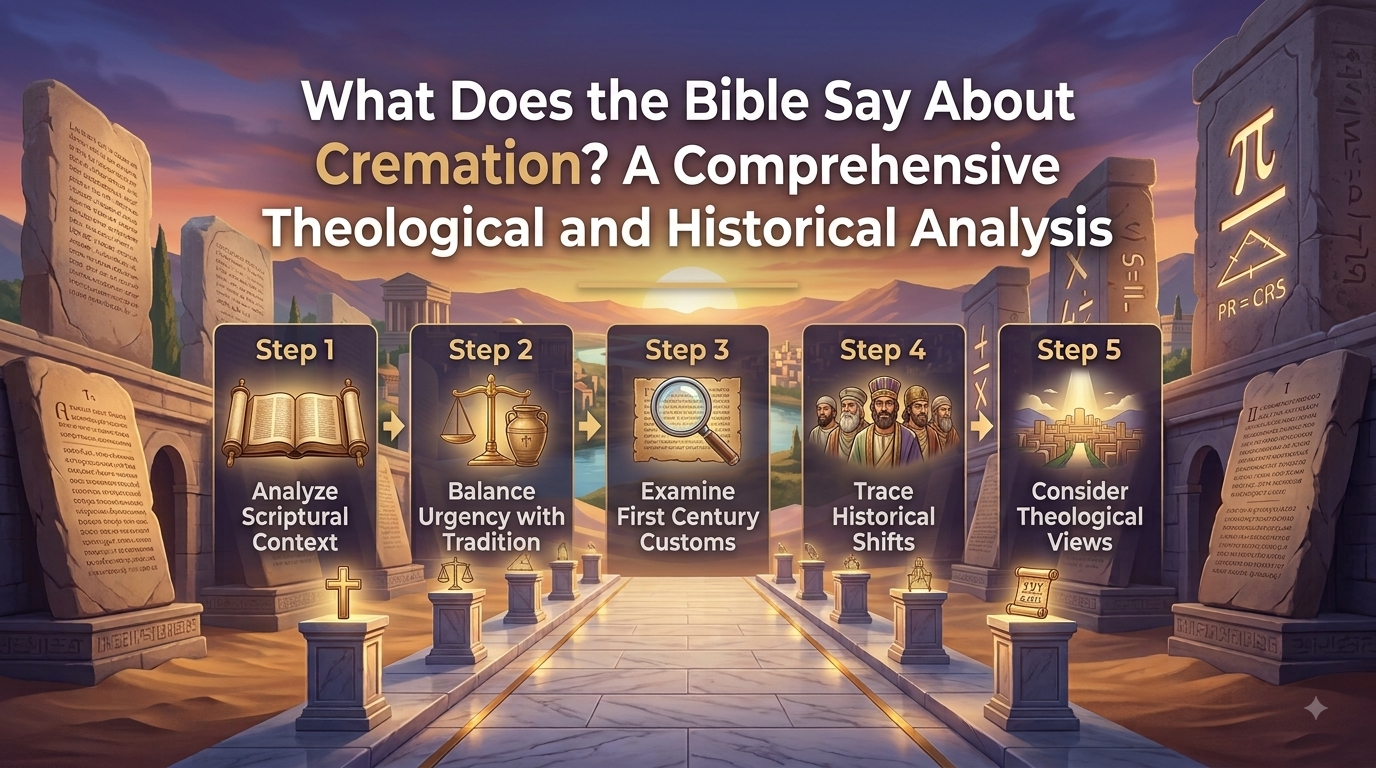
Questions regarding end-of-life decisions, bodily resurrection, and funeral customs are among the most deeply personal topics in Christian theology. As cultural practices shift globally toward modern burial alternatives, many believers find themselves asking a crucial question: what does the Bible say about cremation?
While the practice has become increasingly common for practical, environmental, and financial reasons, Christians often look to Sacred Scripture to discern whether choosing burning over traditional burial aligns with biblical principles. To understand what does the Bible say about cremation, one must examine the explicit references to body disposal in the Old and New Testaments, the historical context of Hebrew and early Christian burial rites, the theological weight placed on the human body, and how major Christian denominations evaluate the practice today.
This exhaustive guide provides a clear, scholarly, and biblically grounded exploration to reveal what does the Bible say about cremation, addressing everything from explicit scripture passages to the hope of bodily resurrection.
1. Direct Biblical References to Fire, Burial, and Body Burning
To evaluate what does the Bible say about cremation, we must begin by recognizing a fundamental scriptural reality: the Bible does not contain an explicit command or prohibition directly addressing modern cremation. The word “cremation” in its modern sense—reducing a human body to bone fragments using intense heat—does not appear in canonical scripture.
However, the scriptures mention several historical instances where human bodies were burned or buried. Examining these passages provides essential context for understanding what does the Bible say about cremation across biblical history.
┌──────────────────────────────────────────────────────────────────────────┐
│ BIBLICAL MODES OF BODY DISPOSAL │
├───────────────────┬──────────────────────────────────────────────────────┤
│ METHOD │ SCRIPTURAL PATTERN & CONTEXT │
├───────────────────┼──────────────────────────────────────────────────────┤
│ Earth / Tomb │ Standard practice for patriarchs, kings, and Jesus │
│ Burning (Honor) │ Rare exception (e.g., King Saul to prevent desecration)│
│ Burning (Judgment)│ Executions for extreme moral transgressions (Leviticus)│
└───────────────────┴──────────────────────────────────────────────────────┘
The Burning of King Saul and His Sons (1 Samuel 31)
One of the most prominent biblical passages involving the burning of bodies is the account of King Saul and his sons after their death in battle against the Philistines.
“When the people of Jabesh Gilead learned what the Philistines had done to Saul, their bravest men traveled through the night to recover the bodies of Saul and his sons. sons from the wall of Beth Shan. They brought the bodies back to Jabesh and burned them there. Then they took their bones and buried them under a tamarisk tree at Jabesh, and fasted seven days.” (1 Samuel 31:11–13)
Here, burning was not a routine funeral rite, but an honorable rescue operation undertaken by valiant men to protect the fallen king’s body from further enemy mutilation and humiliation. Their act was subsequently praised by King David (2 Samuel 2:4–7).
Fire as Judgment in Old Testament Law
When reviewing what does the Bible say about cremation in Mosaic law, fire is frequently associated with divine judgment or execution for grave transgressions rather than normal funerary honor:
- Leviticus 20:14: “If a man marries both a woman and her mother, it is depravity. Both he and they must be burned in the fire, so that no depravity will exist among you.”
- Leviticus 21:9 states that if a priest’s daughter profanes herself through prostitution, she brings dishonor upon her father and is to be burned by fire.
- Joshua 7:25: After Achan violated God’s command regarding the devoted things of Jericho, “all Israel stoned him, and after they had stoned the rest, they burned them.”
These passages demonstrate that in ancient Israelite culture, burning a body was usually associated with punishment or the eradication of dishonor, which explains why ancient Hebrews favored traditional earth or cave burials.
2. Ancient Hebrew Funeral Customs and Cultural Context
To fully grasp what does the Bible say about cremation, it is crucial to understand ancient Near Eastern culture. For the early Israelites and patriarchs, how a person was laid to rest reflected their faith in God’s covenantal promises.
The Standard Pattern: Inhumation and Cave Burial
Throughout the Old Testament, burial in the ground, in natural caves, or in rock-hewn tombs was the near-universal standard practice:
- Abraham and Sarah: Abraham purchased the cave of Machpelah near Hebron as a family burial site (Genesis 23:19).
- Jacob and Joseph: Both Jacob and Joseph gave specific deathbed instructions that their remains be carried out of Egypt to be buried in the Promised Land (Genesis 49:29–33; Genesis 50:24–26; Joshua 24:32).
- The Kings of Judah: Repeatedly in the Books of Kings and Chronicles, righteous kings were said to be “buried with their fathers” in honorable tombs.
┌──────────────────────────────────────────────────────────────────────────┐
│ THE ANCIENT ISRAELITE BURIAL PROCESS │
├──────────────────────────────────────────────────────────────────────────┤
│ │
│ Phase 1: Primary Burial │
│ Body washed, anointed, and laid on a stone bench inside a rock tomb. │
│ │ │
│ ▼ (Decomposition over 12 months) │
│ Phase 2: Secondary Burial (“Gathered to Fathers”) │
│ Bones collected and placed inside an ossuary or central bone pit. │
│ │
└──────────────────────────────────────────────────────────────────────────┘
In ancient Israel, a proper burial was seen as a sign of respect and honor. Conversely, being left unburied to be eaten by birds or wild animals—or being reduced to ashes as a sign of total destruction—was considered a tragedy or a curse (1 Kings 14:11; Jeremiah 16:4). This historical backdrop helps explain why scriptures default to earth or tomb burial when discussing end-of-life care.
3. The New Testament Framework: Death, Burial, and Christ’s Resurrection
When Christians analyze what does the Bible say about cremation, the New Testament provides a deeper theological lens centered around Jesus Christ’s incarnation, death, burial, and bodily resurrection.
The Burial of Jesus Christ
The four canonical Gospels dedicate significant detail to the burial of Jesus:
- Jesus’ body was lovingly requested from Pontius Pilate by Joseph of Arimathea.
- It was wrapped in clean linen cloth along with aromatic spices (myrrh and aloes) provided by Nicodemus (John 19:39–40).
- It was laid in a brand-new rock-cut tomb sealed with a large rolling stone.
For centuries, early Christians viewed the burial of Jesus as the pattern for their own death practices. Just as Christ was laid in the earth and raised in glory, believers saw earth burial as an act of imitating their Savior.
┌──────────────────────────────────────────────────────────────────────────┐
│ PAUL’S AGRICULTURAL METAPHOR FOR RESURRECTION │
├──────────────────────────────────────────────────────────────────────────┤
│ │
│ The Earthly Body ──────► “Sown” into the Earth ──────► Raised in Glory │
│ (Perishable Seed) (Burial) (Imperishable) │
│ │
└──────────────────────────────────────────────────────────────────────────┘
Apostle Paul’s Agricultural Metaphor (1 Corinthians 15)
In 1 Corinthians 15, the Apostle Paul uses the metaphor of planting a seed to describe physical death and future resurrection:
“So will it be with the resurrection of the dead. The body that is sown is perishable, it is raised imperishable; it is sown in dishonor, it is raised in glory; it is sown in weakness, it is raised in power; it is sown a natural body, it is raised a spiritual body.” (1 Corinthians 15:42–44)
Because Paul used the verb “sown” ($\sigma \pi \epsilon \acute{\iota} \rho \omega$), early Christians favored subterranean burial (catacombs) and inhumation, viewing the body as a seed placed in the soil waiting for the final harvest at Christ’s return.
4. Does Cremation Limit God’s Power to Resurrect the Body?
A common question that arises when studying what does the Bible say about cremation is whether reducing a human body to ashes impedes God’s ability to raise that person at the final resurrection.
The Omnipotence of God
Scripture makes it abundantly clear that God’s power is unlimited and not constrained by the physical state of human remains:
$$\text{God’s Sovereignty} \implies \text{Full Restoration of Remains Regardless of Physical Form}$$
Consider the following facts of nature and biblical truth:
- Natural Decomposition: Over time, every buried body decomposes into soil, dust, and basic elemental compounds (“for dust you are and to dust you will return”, Genesis 3:19).
- Historical Circumstances: Countless faithful martyrs were burned at the stake, devoured by wild beasts in Roman arenas, lost at sea, or vaporized in catastrophic events.
- The Prophetic Vision of Ezekiel: In Ezekiel 37 (The Valley of Dry Bones), God demonstrates His power to bring breath, flesh, and life back to long-scattered, bone-dry fragments.
At the resurrection, God creates a transformed, glorified body ($1 \text{ Corinthians } 15:52$). Whether a body decomposed over a century in a wooden casket or was reduced to ashes in a modern crematorium in two hours, God possesses the absolute power to reconstitute and glorify the believer’s body. Therefore, cremation does not limit God’s capability to raise the dead.
5. Major Christian Denominational Perspectives on Cremation
Understanding what does the Bible say about cremation also involves exploring how different Christian traditions interpret scripture regarding end-of-life choices.
┌──────────────────────────────────────────────────────────────────────────┐
│ DENOMINATIONAL POSITIONS ON CREMATION │
├───────────────────────┬──────────────────────────────────────────────────┤
│ DENOMINATION / BRANCH │ OFFICIAL POSITION & GUIDELINES │
├───────────────────────┼──────────────────────────────────────────────────┤
│ Eastern Orthodoxy │ Prohibited (Strong insistence on traditional burial)│
│ Roman Catholicism │ Permitted (Prefer burial; ashes must be entombed)│
│ Protestant (Mainline) │ Fully accepted (Viewed as a matter of Christian liberty)│
│ Evangelical / Baptist │ Generally accepted (Personal preference and intent)│
└───────────────────────┴──────────────────────────────────────────────────┘
The Eastern Orthodox Church
The Eastern Orthodox Church maintains the strictest historical opposition to cremation. Orthodoxy emphasizes that the body is a temple of the Holy Spirit ($1 \text{ Corinthians } 6:19$) and an integral part of the human person, not merely a disposable vessel. Consequently, Orthodox priests generally will not perform funeral services for individuals who intentionally choose cremation over earth burial.
The Roman Catholic Church
Historically, the Catholic Church prohibited cremation due to its association with 19th-century secularist movements that rejected belief in bodily resurrection. However, in 1963, Pope Paul VI relaxed this restriction through the instruction Piam Et Constantem:
- Cremation is permitted provided it is not chosen as a denial of faith in the resurrection.
- In 2016, the Vatican issued Ad resurgendum cum Christo, clarifying that while cremation is allowed, cremated remains (ashes) must be placed in a sacred space (such as a cemetery or columbarium). Scattering ashes or keeping them at home is discouraged to preserve dignity and community remembrance.
Protestant and Evangelical Churches
Most Protestant denominations (including Lutheran, Methodist, Presbyterian, Baptist, and nondenominational evangelical churches) view cremation as a neutral practice not explicitly forbidden by scripture. They consider it a matter of Christian liberty and personal stewardship, provided the decision is made with an attitude of reverence and faith in Jesus Christ.
6. Key Ethical, Stewardship, and Practical Considerations
When evaluating what does the Bible say about cremation for personal or family planning, several practical and spiritual principles come into play:
1.Step 1: Examine the Intentions of the Heart:Heart Motivation.
Scripture emphasizes that God looks beyond outward appearances and examines the heart (1 Samuel 16:7). Is the choice driven by practical stewardship, or by a desire to reject Christian hope? If done in faith, cremation is not sinful.
2.Step 2: Consider Financial Stewardship:Financial Stewardship.
Burial costs can create significant financial burdens for surviving family members. The Bible encourages wise financial management and caring for loved ones without placing unnecessary burdens upon them (1 Timothy 5:8).
3.Step 3: Respect Family Sentiments and Conscience:Family Unity.
End-of-life decisions should foster peace among surviving family members (Romans 12:18). If cremation causes severe spiritual distress to close Christian family members, love and unity should guide the decision.
4.Step 4: Ensure a Respectful Memorial:Honor and Reverence.
Whatever method of disposition is chosen, the memorial or funeral service should honor God, commemorate the deceased person’s life, and proclaim the hope of the gospel.
Summary: What Does the Bible Say About Cremation? Understanding Scripture and Christian Views
In conclusion, when summarizing what does the Bible say about cremation:
- No Explicit Prohibition: The Bible nowhere explicitly forbids modern cremation or declares it a sin.
- Historical Preference for Burial: The ancient Hebrews, early Christians, and Jesus Himself were laid to rest through traditional burial practices, making inhumation the historic scriptural pattern.
- No Barrier to Resurrection: Cremation does not impede God’s sovereign power to raise believers with transformed, glorified bodies at the final resurrection.
- Matter of Christian Liberty: For modern believers, deciding whether to choose burial or cremation is a personal decision grounded in Christian faith, stewardship, heart intent, and mutual family respect.