
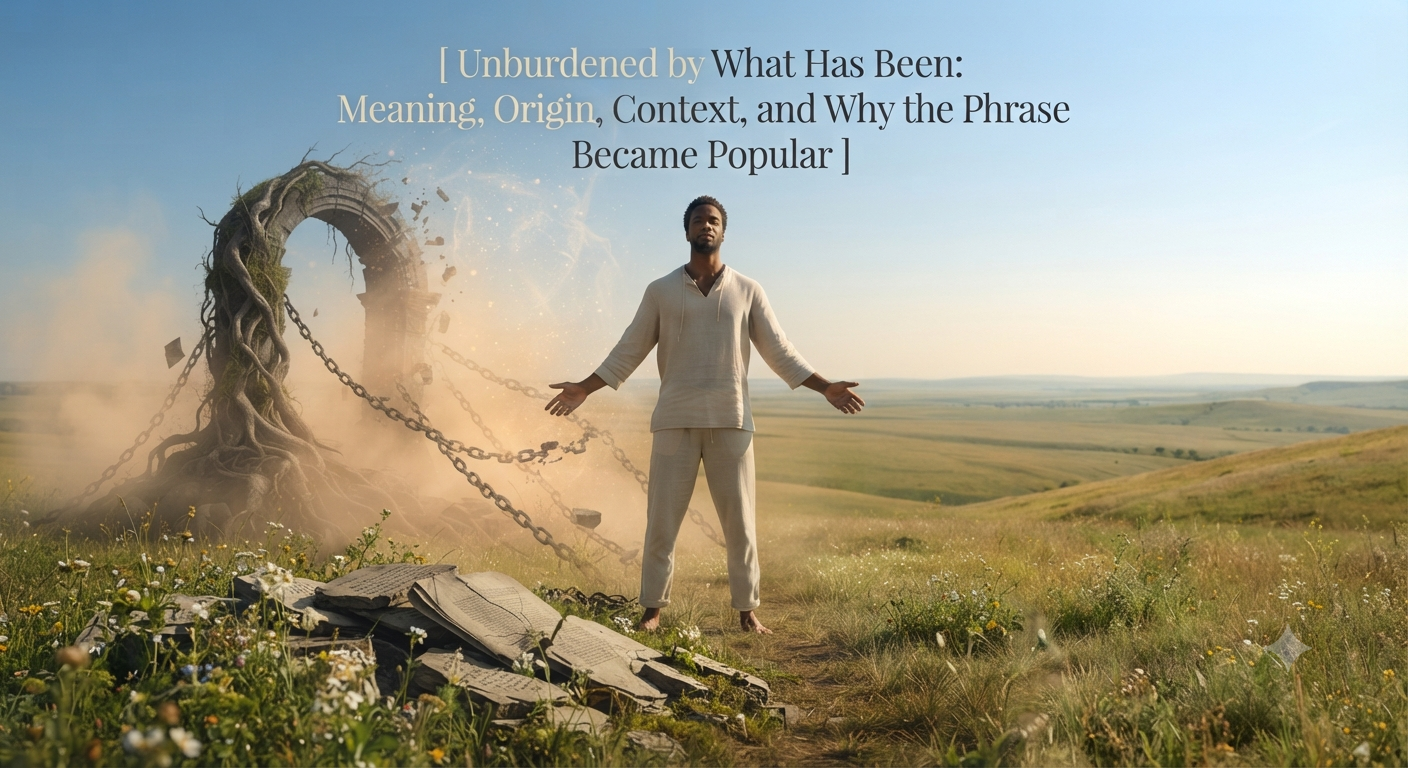
Language has the power to inspire, challenge, and shape public conversations. Certain phrases become memorable because they capture an idea in just a few words, while others gain attention through repeated use in speeches, interviews, and media coverage. One such phrase is “unburdened by what has been.” In recent years, it has appeared in news reports, social media discussions, political commentary, and everyday conversations, leading many people to ask what it actually means.
This sentence has taken on different meanings in various different situations and contexts. Some see the slogan as an uplifting call for people to overcome their difficulties and look towards a better tomorrow. This expression can also appear as discussion of some politically oriented slogan or utterance, political speech, its repetitive usage into speeches of politicians. Regardless of perspectives the slogan can be classified as part of contemporary spoken media with popular resonance.
This guide explores the meaning of unburdened by what has been, where it came from, why it became well known, how it has been interpreted, and why it continues to be discussed.
What Does “Unburdened by What Has Been” Really Mean?
At its core, unburdened by what has been expresses the idea of moving forward without allowing past events, mistakes, limitations, or expectations to completely determine the future.
Breaking the phrase into parts makes its meaning clearer:
- Unburdened means free from a heavy load, responsibility, or obstacle.
- What has been refers to past experiences, previous circumstances, traditions, or historical events.
Combined, the phrase suggests looking ahead rather than remaining constrained by the past. It encourages people to imagine new possibilities instead of assuming the future must repeat what has already happened.
Although the wording is simple, its meaning can vary depending on the situation in which it is used.
Where Did the Phrase Come From?
The phrase unburdened by what has been became widely recognized through speeches by Kamala Harris. She frequently used the expression when speaking about opportunity, leadership, education, public policy, and the future of the country, making it a notable example of political speech communication in modern public discussions.
As it popped up in more speeches, rallies and interviews, it was naturally tied to her messaging and rhetoric. News media, commentators, supporters and critics started using it, among them: (That repetition made it recognizable.). There are versions of saying not to repeat the past, and looking to the future throughout history.
Understanding the Phrase in Context
When examining unburdened by what has been, context matters.
In many speeches, the phrase is used to encourage people to think beyond existing limitations. Rather than suggesting that history should be forgotten, it emphasizes that previous challenges do not necessarily have to define future possibilities.
For example, the phrase may be applied when discussing:
- Educational opportunities.
- Economic development.
- Scientific innovation.
- Social progress.
- Personal growth.
- Community improvement.
In these contexts, the message is generally one of optimism and forward-looking thinking.
Why Did the Phrase Become So Popular?
Several factors contributed to the popularity of unburdened by what has been.
Repetition
Public figures often repeat key phrases to reinforce important themes. Because this expression appeared frequently in speeches, many people began to recognize it immediately. The use of rhetorical techniques in public speaking helps explain why certain phrases become memorable and widely discussed.
Media Coverage
Television networks, newspapers, podcasts, and online publications frequently quoted the phrase while covering political events. This increased public familiarity with the wording.
Social Media
However, soon the slogan became famous on various social media channels. While many people downloaded clips containing the slogan, other people explained their meaning and came up with their interpretation or memes. In doing so, the latter reached those who were not able to watch the live broadcast of the original statements.
Memorable Wording
The expression stands out because it is somewhat poetic and reflective rather than conversational. Its unusual structure makes it easier to remember than many everyday political slogans.
Different Interpretations of “Unburdened by What Has Been”
One reason unburdened by what has been continues to generate discussion is that people interpret it in different ways.
A Message of Hope
Many people understand the phrase as an encouragement to overcome obstacles, learn from previous experiences, and build a better future.
A Leadership Principle
Others see it as a leadership philosophy suggesting that effective decision-makers should remain open to innovation rather than relying solely on past approaches.
A Personal Mindset
Outside politics, some individuals apply the phrase to personal development. It can be interpreted as letting go of regrets, failures, or limiting beliefs in order to focus on future goals.
A Subject of Public Debate

Because the phrase became closely associated with political speeches, it has also been discussed, analyzed, praised, and criticized within broader conversations about communication and public messaging.
Each interpretation reflects the perspective of the person using or discussing the phrase.
Is the Phrase About Ignoring History?
A common misunderstanding is that unburdened by what has been suggests forgetting or dismissing the past.
In most contexts, that is not how the phrase is intended.
Rather, most of the time it communicates that you cannot hinder people from seeking fresh notions or improving circumstances in order to be inspired by lessons taught in the history of man. It isn’t an “in-spite-of”. Quite the contrary. We have all observed such remarks from leaders, thinkers as well as teachers to encourage people to challenge things to build a greater better positive reality.
How the Phrase Is Used Outside Politics
Although unburdened by what has been gained recognition through political speeches, its underlying message can apply to many aspects of everyday life.
For example, someone starting a new career after previous setbacks may describe themselves as wanting to be “unburdened by what has been.” Likewise, a business launching an innovative product or a community rebuilding after challenges might use similar language to emphasize future possibilities rather than past limitations.
Because the phrase has a broader motivational theme, it has gradually appeared in discussions about education, leadership, personal growth, and organizational change.
Why the Phrase Became a Cultural Reference
As unburdened by what has been appeared repeatedly in speeches, interviews, and public events, it gradually became more than just a line from a political address. It evolved into a recognizable cultural reference that many people could immediately identify.
That phrase is interesting due to its structure alone, not because it’s short like slogans, cliché like motivational quotes or even because they just happened to decide to use that exact string of words in a campaign. The unfamiliar construction of the words made them easily quotable for media commentators, comics and anyone talking about politics online or for whatever reason seemed to find it suited to their purposes.
Over time, unburdened by what has been became part of broader conversations about political communication, public speaking, and leadership messaging.
How Social Media Increased Its Popularity
Social media played a significant role in making unburdened by what has been widely recognized. The impact of social media and political communication shows how digital platforms can influence the spread and interpretation of public messages.
Short video clips, speech excerpts, reaction videos, and online discussions spread quickly across multiple platforms. People used the phrase in different ways:
- Discussing its intended meaning.
- Sharing memorable speech moments.
- Creating humorous memes.
- Debating political messaging.
- Applying the phrase to everyday situations.
- Using it as a motivational quote.
Because social media encourages rapid sharing and repetition, the phrase reached millions of people who may not have followed the original speeches.
Supporters’ Perspective
Many supporters interpret unburdened by what has been as an optimistic message about possibility and progress.
From this perspective, the phrase encourages individuals and communities to avoid becoming trapped by previous setbacks or long-standing assumptions. Instead, it suggests looking ahead with creativity and confidence.
Supporters often believe the expression emphasizes:
- Hope for the future.
- Innovation.
- Personal growth.
- Community improvement.
- Learning from history while embracing change.
- Expanding opportunities for future generations.
For these audiences, unburdened by what has been serves as a reminder that today’s decisions can create a different tomorrow.
Critics’ Perspective

Like many well-known political phrases, unburdened by what has been has also received criticism.
Some critics argue that the wording is overly abstract or philosophical, making it less accessible to general audiences. Others believe that repeating the phrase frequently reduced its impact over time.
In political discussions, critics have sometimes questioned whether the phrase clearly communicates specific policy ideas or practical solutions.
These differing opinions reflect the broader reality that memorable political language is often interpreted differently depending on personal experiences, political views, and communication preferences.
The Role of Repetition in Public Speaking
One reason unburdened by what has been became so recognizable is the strategic use of repetition.
Public speakers often repeat important phrases because repetition can:
- Reinforce central themes.
- Make ideas easier to remember.
- Create consistency across speeches.
- Build a recognizable communication style.
- Help audiences recall key messages.
Throughout history, many influential leaders have repeated specific expressions to emphasize their priorities. In this case, repeated use helped establish unburdened by what has been as one of the most recognizable phrases associated with recent political speeches.
What the Phrase Can Mean in Everyday Life
Although unburdened by what has been is commonly discussed in politics, its message can also apply to personal and professional situations.
So, for example, someone changing their profession after several years in another can look towards opportunities ahead rather than failures that may have come their way. Alternatively a student after doing badly in exams might consider improving further, rather than focusing on bad scores on previous exams. Businesses themselves will frequently start looking forwards after suffering economic hardship and might invest in innovative technologies rather than traditional ways of doing things. In these situations the idea clearly is used to represent someone that shows resilience and has overcome their challenges or simply someone who can take the change without issue.
Why the Phrase Continues to Trend Online
Even years after its first widespread use, unburdened by what has been continues to appear in online searches and discussions.
Several factors contribute to its lasting visibility:
- News coverage referencing earlier speeches.
- Renewed interest during election cycles.
- Educational discussions about political communication.
- Viral social media content.
- Curiosity from people hearing the phrase for the first time.
- Ongoing debates about leadership and public messaging.
Because it has become associated with a particular speaking style, the phrase often resurfaces whenever public communication becomes a topic of discussion.
Myths and Misconceptions About “Unburdened by What Has Been”
Myth 1: The phrase means forgetting history.
This is a common misunderstanding. In most contexts, unburdened by what has been encourages people not to let the past completely limit future possibilities. It does not necessarily suggest ignoring historical events or lessons.
Myth 2: The phrase applies only to politics.
While it became famous through political speeches, its broader message about moving beyond limitations can also apply to education, business, leadership, and personal development.
Myth 3: It has only one interpretation.
Language often allows for multiple interpretations. Different audiences may understand the phrase in different ways based on context and personal perspective.
Myth 4: The phrase appeared suddenly without context.
Although it gained widespread attention through repeated public speeches, the broader idea of learning from the past while focusing on the future has long appeared in literature, philosophy, and leadership discussions.
Why Understanding Context Matters
When interpreting unburdened by what has been, context is essential.
The same words can communicate different ideas depending on:
- The speaker.
- The audience.
- The subject being discussed.
- The historical moment.
- The purpose of the speech.
Looking at the surrounding discussion rather than focusing on a single sentence provides a clearer understanding of the intended message.
This is true not only for political speeches but for public communication in general.
The Lasting Impact of the Phrase
Regardless of differing opinions, unburdened by what has been has become one of the most recognizable expressions in recent American political communication.
The endurance of the line is an example of how persistent language can alter the contours of the public sphere and seep into our everyday lexicon. Whether it’s understood as an inspirational rallying cry, a catchy phrase that memorizes its point or a source of political debate, the slogan remains a focal point for reflecting upon time.
Conclusion
It is said the phrase unburdened by what has been has become “a ubiquitous trope in modern political discourse.” Driven into common public vocabulary through a barrage of political rhetoric it generally means that you must not let previous events affect future prospects. The way in which the words are used will depend on the context and the people concerned but the underlying idea is one of optimism, new departure, the idea of change and the development of innovation, new and modern approaches.
If it has been embraced with one hand with enthusiasm by supporters, there is another hand at work that does not find the word choice a suitable approach to communication.
It is not without some controversy regarding word choice and how to deal with words that are potentially problematic. Examining the context in which unburdened by what has been used is key to understanding the message. This, as with all memorable statements in the public arena, can be put down to speaker, audience and overall debate.
Frequently Asked Questions
1. What does “unburdened by what has been” mean?
It generally means moving forward without allowing past events, limitations, or experiences to completely determine future possibilities.
2. Who made the phrase “unburdened by what has been” well known?
The phrase became widely recognized through speeches by Kamala Harris, who used it repeatedly in various public appearances.
3. Is “unburdened by what has been” a political slogan?
It is best described as a recurring phrase or rhetorical expression rather than an official slogan. It became closely associated with political speeches because of its repeated use.
4. Does the phrase mean ignoring history?
No. In most contexts, it encourages people to learn from the past while not allowing previous challenges or assumptions to prevent future progress.
5. Why did the phrase become so popular?
Its repeated use in speeches, extensive media coverage, and widespread sharing on social media helped make it a recognizable cultural reference.
6. Can the phrase be used outside politics?
Yes. It can also describe personal growth, leadership, education, business innovation, and other situations where people focus on future opportunities instead of past limitations.
7. Why do people interpret the phrase differently?
Language is often shaped by context and personal perspective. People may understand the phrase differently depending on their experiences, beliefs, and the situation in which it is used.
8. Why is “unburdened by what has been” still discussed today?
Why is this phrase still used today? This phrase still continues to influence our conversations on politics because it influences how we discuss, and speak about not just political communication but also leaders, or, more broadly, the manner in which we negotiate between past achievements and aspirations for future possibilities.