
What Is Backup Withholding?
Taxes can be confusing, especially when unfamiliar terms appear on tax forms or financial statements. One term that often surprises taxpayers is backup withholding. Many people first encounter it after receiving a notice from a financial institution or seeing money withheld from interest, dividends, or other payments. Naturally, they begin asking what is backup withholding, why it happened, and whether they can get the money back.
Backup withholding is a federal income tax withholding requirement in the United States that is managed under IRS tax withholding rules for certain reportable payments and taxpayer situations.. It applies in certain situations when a payer must withhold a percentage of specific payments and send that money directly to the Internal Revenue Service (IRS). Unlike regular payroll withholding, backup withholding generally applies to certain non-wage payments, such as interest, dividends, rents, royalties, and payments made to independent contractors under specific circumstances.
Understanding what is backup withholding is important because it can affect your cash flow and tax filing. In many cases, backup withholding is preventable if your taxpayer information is accurate and up to date. Even if money has already been withheld, it may be credited toward your federal income tax liability when you file your tax return.
This comprehensive guide explains what is backup withholding, how it works, who it affects, why it happens, current withholding rates, exemptions, and practical steps you can take to avoid it.
What Is Backup Withholding?
The simplest answer to what is backup withholding is that it is a federal tax withholding system used by the IRS to ensure taxes are collected when certain taxpayer identification or reporting requirements are not met.
Instead of paying you the full amount, the organization making the payment withholds a percentage and sends it directly to the IRS on your behalf.
Backup withholding is not an additional tax. Rather, it is an advance payment of your federal income tax. When you file your annual tax return, the amount withheld is generally credited against the taxes you owe. If too much tax was withheld, you may receive a refund.
Why Does Backup Withholding Exist?
Backup withholding was created by the IRS to promote tax compliance and ensure more accurate reporting of income.
Many types of payments are reported to the IRS by banks, brokerage firms, businesses, and other financial institutions. If taxpayer information is missing, incorrect, or inconsistent, the IRS may require backup withholding to ensure that at least part of the tax is collected.
Understanding what is backup withholding also means understanding that its primary purpose is protecting tax compliance rather than penalizing taxpayers.
How Does Backup Withholding Work?
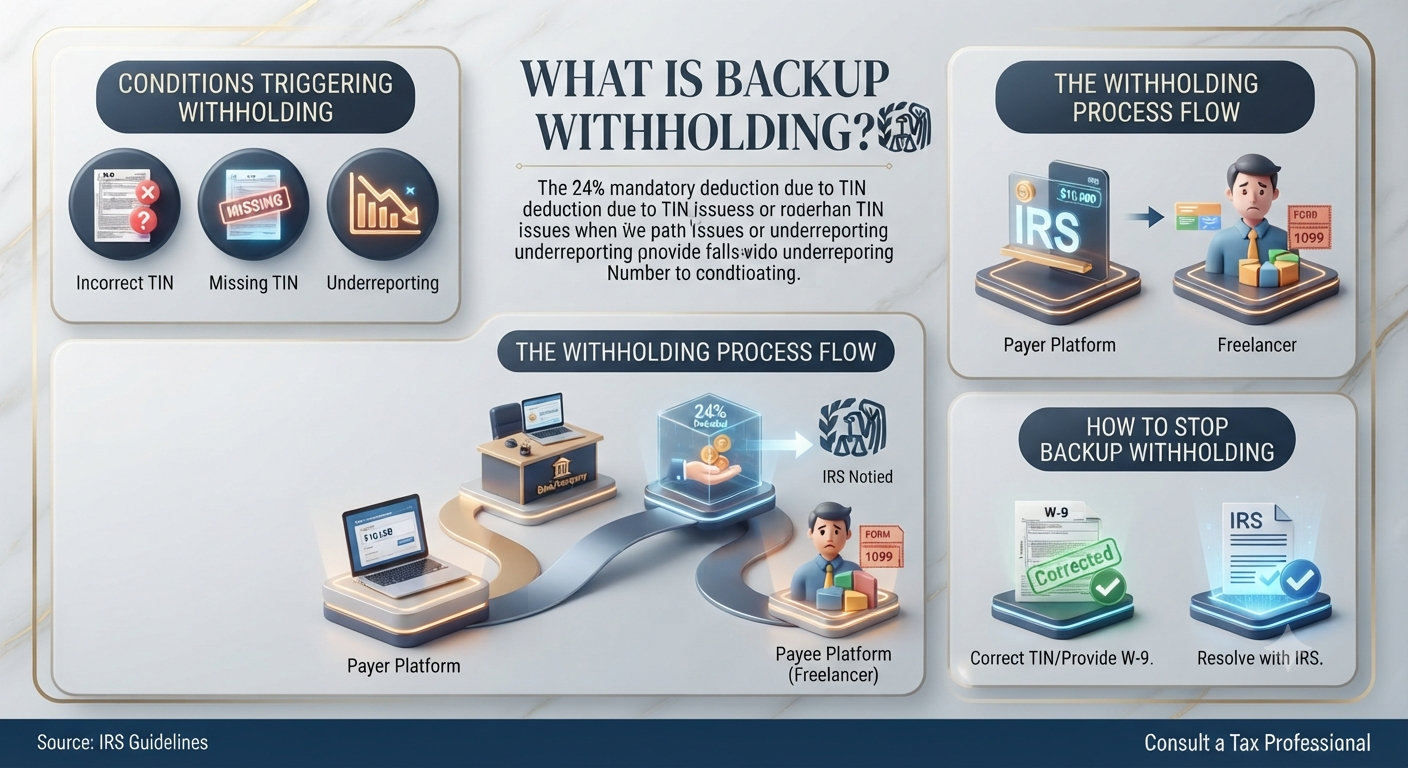
Backup withholding follows a relatively straightforward process.
- A payer makes a reportable payment.
- The payer determines whether backup withholding applies.
- If required, the payer withholds a percentage of the payment.
- The withheld amount is sent directly to the IRS.
- The recipient reports both the income and the withheld tax on their federal income tax return.
For example, if you receive reportable income that is subject to backup withholding, you may receive less money than expected because part of the payment has already been forwarded to the IRS.
What Is the Current Backup Withholding Rate?
The current federal backup withholding rate is 24%.
This means that if backup withholding applies to a reportable payment, the payer generally withholds 24% of the payment before sending the remaining amount to the recipient.
For example:
- Reportable payment: $1,000
- Backup withholding (24%): $240
- Amount paid to recipient: $760
The withheld $240 is generally credited toward the recipient’s federal income tax when they file their return.
What Types of Payments Can Be Subject to Backup Withholding?
People searching what is backup withholding are often surprised to learn that it applies to many different types of income.
Examples include:
- Interest income
- Dividend payments
- Certain independent contractor payments
- Royalties
- Rents
- Broker and barter exchange transactions
- Some gambling winnings
- Certain government payments
- Other reportable payments required under federal tax rules
Not every payment is automatically subject to backup withholding. The withholding generally applies only when specific IRS requirements are triggered.
When Does Backup Withholding Apply?
Several situations may cause backup withholding.
1. Incorrect Taxpayer Identification Number (TIN)
One of the most common reasons is providing an incorrect Taxpayer Identification Number (TIN).
For individuals, this is usually a Social Security number (SSN).
If the payer cannot verify the number, backup withholding may become necessary.
2. Failure to Provide a TIN
If you fail to provide your TIN when required, the payer may be legally obligated to begin backup withholding.
This often occurs when completing tax forms such as Form W-9.
3. IRS Notification
The IRS may notify a payer that a taxpayer has underreported certain types of income in previous years.
In some situations, this notification requires the payer to begin backup withholding until the IRS instructs otherwise.
4. Incorrect Certification
When completing Form W-9, taxpayers generally certify that:
- Their TIN is correct.
- They are not currently subject to backup withholding (unless notified otherwise).
- They are a U.S. person or otherwise eligible to make the certification.
Providing incorrect information may trigger withholding requirements.
Who Can Be Affected by Backup Withholding?
Many different individuals and businesses can potentially encounter backup withholding.
Examples include:
- Investors receiving dividends.
- People earning bank interest.
- Independent contractors.
- Freelancers.
- Consultants.
- Landlords receiving certain reportable payments.
- Individuals receiving royalties.
- Some business owners.
Although not everyone will experience backup withholding, understanding what is backup withholding helps taxpayers recognize situations where it may arise.
What Is Form W-9?

A key document related to what is backup withholding is Form W-9, which taxpayers use to provide their correct name, taxpayer identification number, and certification information to businesses and financial institutions.
Form W-9 allows individuals and businesses to provide:
- Their legal name.
- Business name (if applicable).
- Taxpayer Identification Number.
- Federal tax classification.
- Certification regarding backup withholding.
Providing accurate information on Form W-9 helps reduce the likelihood of unnecessary backup withholding.
Is Backup Withholding the Same as Payroll Withholding?
No.
Many people confuse backup withholding with the federal income tax withheld from employee paychecks.
The two systems are different.
Payroll withholding applies to wages earned by employees and is based on payroll tax rules.
Backup withholding generally applies to certain reportable non-wage payments when IRS requirements are triggered.
Does Backup Withholding Mean You Owe More Taxes?
Not necessarily.
This is one of the biggest misconceptions about what is backup withholding.
Backup withholding is generally a prepayment of federal income tax.
When you file your annual federal income tax return, the amount withheld is usually credited against your overall tax liability.
When your tax withholding is higher than the amount you owe, you may receive a refund after filing your tax return.
How to Stop Backup Withholding
After learning what is backup withholding, many taxpayers want to know how to prevent it from continuing. In most situations, backup withholding can be stopped once the underlying issue has been corrected.
The exact process depends on why the withholding began, but common steps include:
Provide a Correct Taxpayer Identification Number (TIN)
If backup withholding started because your Social Security number (SSN), Employer Identification Number (EIN), or other Taxpayer Identification Number (TIN) was missing or incorrect, submit the correct information to the payer.
For many businesses and financial institutions, this is done by completing a new IRS Form W-9.
Respond to IRS Notices
If the IRS has notified you that you’re subject to backup withholding due to underreported income or another tax reporting issue, read the notice carefully and follow its instructions.
In some cases, you’ll need to resolve the issue directly with the IRS before the payer can stop withholding.
Verify Your Information
Make sure your:
- Legal name
- Taxpayer Identification Number
- Tax classification
- Business information (if applicable)
match IRS records.
Even a simple mismatch between your name and TIN can sometimes trigger backup withholding.
Can You Get Backup Withholding Money Back?
One of the most common questions after asking what is backup withholding is whether the withheld money is lost forever.
Fortunately, the answer is usually no.
Backup withholding is generally treated as a payment toward your federal income tax.
When you file your federal tax return, you report:
- The income you received.
- The amount withheld.
The withheld amount is then credited against your total tax liability.
If too much tax was withheld, you may receive the difference as a tax refund.
Who Is Exempt From Backup Withholding?
Although backup withholding affects many taxpayers, some individuals and organizations may be exempt under IRS guidelines.
Examples may include some:
- Government agencies.
- Tax-exempt organizations.
- Certain corporations.
- Financial institutions in qualifying situations.
- Other entities specifically identified under IRS regulations.
An exemption may apply based on the nature of the payment and the recipient’s tax classification. Individuals should not assume they are exempt without confirming the applicable IRS rules.
Common Mistakes That Trigger Backup Withholding
Understanding what is backup withholding also means knowing how to avoid common errors.
Providing the Wrong TIN
Entering an incorrect Social Security number or Employer Identification Number is one of the most frequent causes.
Forgetting to Complete Form W-9
Businesses often request Form W-9 before making certain reportable payments.
Failing to complete the form may result in backup withholding.
Ignoring IRS Notices
If the IRS sends a notice requesting action, delaying your response may allow backup withholding to continue longer than necessary.
Underreporting Income
If reportable income is omitted from a federal tax return, the IRS may eventually require backup withholding on certain future payments.
Reporting all taxable income accurately helps reduce this risk.
Backup Withholding vs. Regular Tax Withholding
Many taxpayers confuse these two forms of withholding.
Here are the key differences:
| Backup Withholding | Payroll Tax Withholding |
| Applies mainly to certain reportable non-wage payments | Applies to employee wages |
| Usually triggered by IRS reporting requirements | Based on payroll withholding rules |
| Current federal rate is generally 24% | The amount can differ based on the tax forms provided and the withholding choices made. |
| Sent directly to the IRS | Also sent to the IRS as payroll tax withholding |
| Credited when filing a tax return | Also credited when filing a tax return |
Although they operate differently, both systems are designed to collect federal income tax throughout the year rather than waiting until tax filing season.
Real-World Examples of Backup Withholding
Practical examples can make what is backup withholding easier to understand.
Example 1: Missing Taxpayer Identification Number
A freelance graphic designer completes a project for a new client but forgets to provide a completed Form W-9.
Until the required tax information is received, the client may need to withhold part of the payment under backup withholding rules.
Example 2: Incorrect Social Security Number
An investor opens a bank account but accidentally enters an incorrect Social Security number.
Because the information does not match IRS records, backup withholding may begin on interest earned until the error is corrected.
Example 3: Underreported Interest Income
A taxpayer fails to report taxable interest income on previous federal tax returns.
After IRS notification and the applicable procedures, future reportable payments could become subject to backup withholding until the issue is resolved.
Tips to Avoid Backup Withholding
Although backup withholding is sometimes unavoidable, following good recordkeeping and tax practices can greatly reduce the chances of experiencing it.
Helpful tips include:
- Provide accurate taxpayer information.
- Complete Form W-9 carefully.
- Double-check your Social Security number or EIN.
- Report all taxable income on your federal tax return.
- Keep your contact information updated with financial institutions.
- Respond promptly to IRS correspondence.
- Maintain copies of tax forms for your records.
These simple habits can help prevent unnecessary withholding and reduce administrative delays.
Why Backup Withholding Is Important
Understanding what is backup withholding is valuable because it helps taxpayers recognize that the system is designed to improve tax compliance rather than impose an additional penalty.
For businesses, complying with backup withholding rules helps avoid reporting issues and potential penalties.
For individuals, knowing when backup withholding applies can prevent unexpected reductions in payments and make tax filing easier.
Being proactive with tax documentation often eliminates many of the situations that trigger backup withholding.
Common Myths About Backup Withholding
Myth 1: Backup withholding is an extra tax.
False. Backup withholding is generally an advance payment of federal income tax, not an additional tax.
Myth 2: Once backup withholding starts, it can never stop.
Incorrect. In many cases, it ends after the underlying issue—such as incorrect taxpayer information—is corrected.
Myth 3: Only independent contractors are affected.
No. Backup withholding can apply to several types of reportable payments, including interest, dividends, royalties, and certain other payments, depending on IRS requirements.
Myth 4: You automatically lose the withheld money.

Not usually. The amount withheld is generally credited on your federal income tax return and may reduce the tax you owe or increase your refund if you overpaid.
Conclusion
If you’ve been wondering what is backup withholding, it is a federal tax withholding requirement that applies to certain reportable payments when taxpayer identification or reporting requirements are not met. Rather than being an additional tax, backup withholding is generally an advance payment of federal income tax that is sent directly to the IRS.
Understanding what is backup withholding can help you avoid unnecessary withholding by providing accurate taxpayer information, completing forms such as Form W-9 correctly, reporting income accurately, and learning more about personal tax planning strategies that can help manage your overall financial responsibilities.
. If backup withholding has already occurred, the withheld amount is typically credited when you file your federal income tax return.
By keeping your tax records accurate and staying informed about IRS reporting requirements, you can reduce the likelihood of backup withholding and better manage your financial obligations.
Frequently Asked Questions
1. What is backup withholding?
Backup withholding is a federal income tax withholding requirement that may apply to certain reportable payments when a taxpayer’s identification or reporting requirements are not satisfied.
2. What is the current backup withholding rate?
The current federal backup withholding rate is 24%.
3. Is backup withholding an additional tax?
No. It is generally treated as a prepayment of your federal income tax and is credited when you file your tax return.
4. What types of payments can be subject to backup withholding?
Examples include certain interest, dividends, royalties, rents, broker payments, some independent contractor payments, and other reportable income, depending on IRS rules.
5. How do I stop backup withholding?
You may be able to stop backup withholding by providing the correct taxpayer information, completing Form W-9 accurately, or resolving the issue identified by the IRS.
6. Can I recover money withheld through backup withholding?
Yes. In most cases, the amount withheld is credited on your federal income tax return and may reduce the tax you owe or increase your refund.
7. Does everyone have to pay backup withholding?
No. Backup withholding applies only in specific situations defined by IRS regulations, and many taxpayers will never encounter it.
8. How can I avoid backup withholding?
You can reduce the risk by providing accurate taxpayer information, reporting all taxable income, completing required tax forms correctly, and responding promptly to IRS notices.