
Whether you find yourself shivering under a meager trickle of a shower, tapping your toe (and tapping and tapping and tapping) while the washing machine slowly fills, or wrestling with a kitchen faucet that just does not yield a usable stream, there are all telltale signs of one underlying issue.But how to fix low water pressure in house depends on something many homeowners overlook: determining where the pressure is being lost.
Often, the answer is less complicated then one would imagine. The shut off valve may only be partially open; the aerator on a faucet may be clogged with calcium; or the showerhead could be obstructed by debris.However, knowing how to fix low water pressure in house also means considering problems that affect the entire property, such as a leaking pipe, failing pressure-reducing valve, undersized or deteriorated plumbing, a well-system issue, or inadequate pressure from the public water supply.
The first step in understanding how to fix low water pressure in house is not immediately turning a regulator screw or buying a booster pump. It is diagnosis. After you’ve identified how much of the system is affected (one fixture, one section of the house, or the whole system), narrowing down the potential causes becomes significantly easier.
Why Low Water Pressure Is Not Always a Pressure Problem
Though many folks might say “low flow” when they mean “low pressure” (and vice versa), the two terms aren’t entirely synonymous. Let’s break down the definitions:Water pressure: Pressure is basically a push that forces water throughout your plumbing lines and into various fixtures. Water flow: The measure of how much water is passing through a fixture or pipe within a certain timeframe.
So, it’s possible to have good incoming pressure but suffer through the indignity of a slow stream to a sink or shower because there’s a clog or impediment to flow: a restriction in a pipe, faucet cartridge or shower head, or a clogged faucet aerator, restrict it.
This difference is why cleaning out your faucet and getting a nice strong stream often helps without really affecting how much the system can ultimately deliver flow (which would relate more directly to the incoming pressure and its capabilities).
When learning how to fix low water pressure in house, it helps to understand what normal pressure should look like. So the American Society of Plumbing Engineers states on a related topic and page “The optimum inlet pressure to plumbing is in the range of approximately 45-60 psi, according to the US Environmental Protection Agencies WaterSense program. High static pressure also puts a huge amount of undue pressure on your existing plumbing, fixtures, and home appliances.” The intent is not just a high reading on a gauge – instead, they desire appropriate flow and consistent appropriate pressure.
Start With One Question: Is the Whole House Affected?
Before taking anything apart, turn on several fixtures separately.
If the kitchen faucet flow is only slow with the others in the home working correctly, it will be localized problem to the kitchen faucet. Check the faucet aerator, water shut off valve, flexible faucet hose, faucet cartridge.
If the cold water flow to all fixtures is slow, the main water shut off valve, water meter connection, pressure regulator, supply line, a leak, and Municipal water supply are all suspects.
If the hot water is the only slow supply issue than the water heater and the shutoff valves related to the water heater will rise up significantly on the list of suspects.
A simple test like this can help avoid the costly replacement of a component when the problem is just a clogged fixture.
How to Test Your Home’s Water Pressure
A pressure gauge that connects to a hose bib is one of the most useful inexpensive diagnostic tools for this problem.
When determining how to fix low water pressure in house, start by measuring the actual pressure rather than relying on how the water feels from a faucet.Hook up at an outside faucet (and one that’s convenient to the point of entry of your home’s main water supply line is often a good bet, of course.) Turn off any faucets, washing machine, dishwasher, sprinkler and any other devices using water. Hook the meter to your hose bib, open the tap to its maximum, and take your measurement.
WaterSense recommends taking the pressure reading with all your fixtures and systems off.
In general, good service pressure is in the ballpark of 45 psi to 60 psi, the sweet spot to aim for to meet the needs of home fixtures. And below around 40 psi will indicate a need to see what’s up, just like an above-80-psi situation, which you wouldn’t just ignore since high pressure could harm your home plumbing or your fixtures. Your reading also isn’t enough context on its own: A decent static pressure measurement doesn’t mean that your flow when someone is running the washing machine (or anything else) will still be good.
If the pressure drops significantly anytime another fixture is running, you have an impediment issue going on, such as a flow problem with the equipment supplying the pressure or an undersized delivery line or a problem elsewhere with the system under flow.
1. Check the Main Water Shutoff Valve
One of the easiest causes to overlook is a partially closed main shutoff valve.
A plumbing shut-off might not have been opened full way after repairs. Older, gate style water main valves can be hard to turn or actually be broken and might not operate even if the handle looks correct open. If the handle of the main valve is open perpendicular to the pipe, it’s usually an open lever style ball valve.
Usually open a wheel style gate handle in a counter-clockwise motion.
Be careful! If a valve is stuck or corroded and difficult to turn, don’t force it. An old main shut-off, when forced, may shatter and lead to an easily repairable water issue becoming a disaster area. Check the street side shut off if you have one; these are often just past where the utilities are buried to connect the municipal line to your house.
Check with the water company how they handle these separately before adjusting.
2. Clean a Clogged Faucet Aerator or Showerhead
When one fixture has low flow, start there.
A faucet aerator is essentially a tiny screen attached to the tip of many faucets. Inside these screens can accumulate deposits of minerals, rust, and other particles. There are similar kinds of restrictions in a showerhead.
Where possible, detach the aerator or showerhead, clean away any obvious debris, and inspect the screen and openings. White vinegar is typically effective at dissolving mineral scale, although it’s best to follow the manufacturers’ directions, especially where there are sensitive finishes.
The EPA notes that regular inspection of faucets for scale or calcium buildup and the removal of deposits that impede flow are important.
This is another case of showing why identifying where the trouble lies is so important. There’s very little reason to tweek the house’s pressure regulators over dirty aerators on a faucet.
3. Look for a Plumbing Leak
A hidden leak can reduce available water flow while also wasting water and potentially causing structural damage.
Check below cabinets/sinks, around the toilet, water heater, wash line plumbing and anything with exposed supply pipes. Look for unexplained moisture, water stains or drips, mildew or moldy smells, or an unexpectedly high water bill.
There’s a meter-based DIY test as well. If the water used in the home (or outdoor irrigation system) is completely turned off for an hour or two and the meter is still running, you most likely have a leak somewhere. According to theEPA, you may be able to detect leaks yourself with this method, and water use is higher in homes with leaks.
Not all leaks are obvious with water puddle in plain view. A leak on a supply pipe hidden within a wall, beneath the floorboards, or underground could be in operation. If pressure dropped quickly, if you hear it running even after turning off taps and if you can turn off the mains feed, find a plumber ASAP.
4. Inspect the Pressure-Reducing Valve
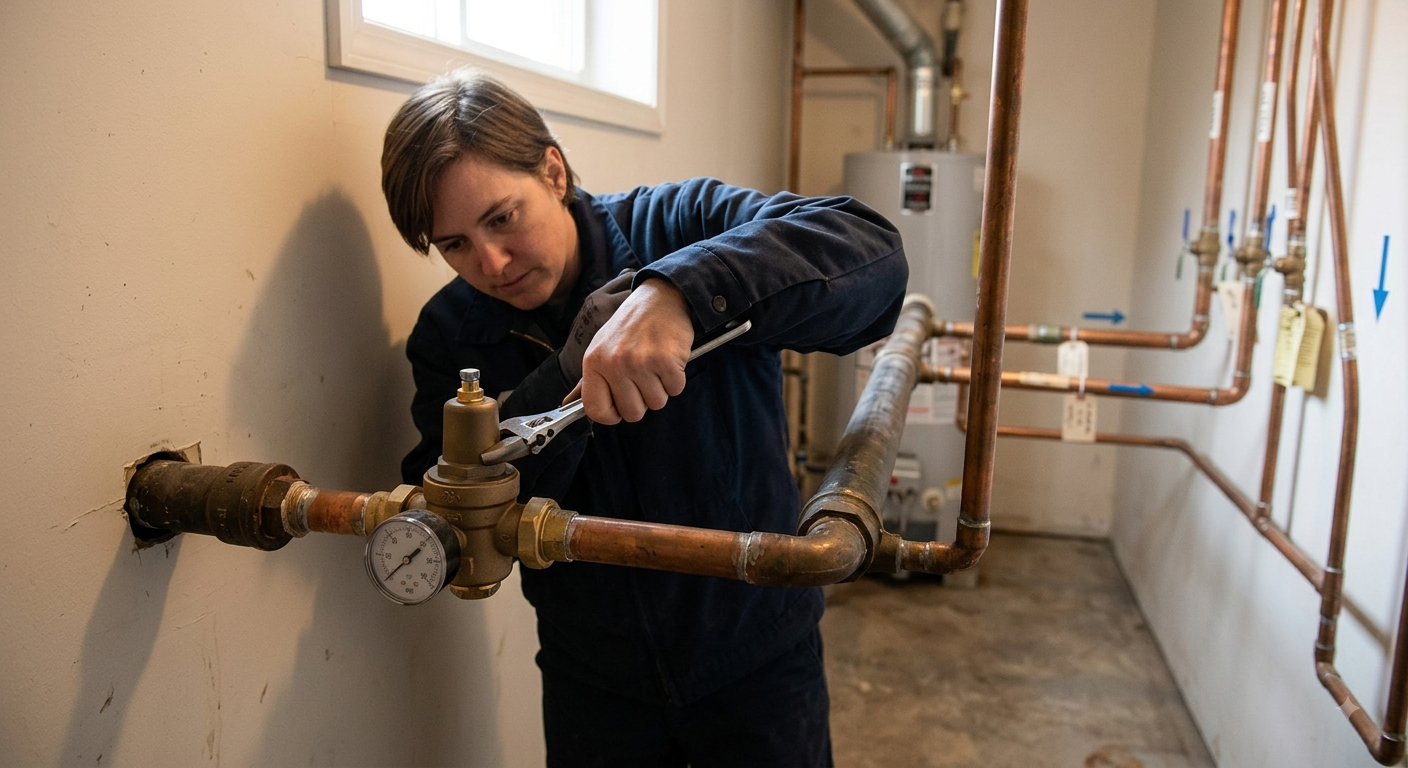
If your house draws water from a municipal system, you might have a pressure-reducing valve (PRV), also known as a pressure regulator, installed at or near where the house water service enters your house. Its function is to prevent too much from the street’s high-pressure water system from entering your house. A problematic regulator will lead to unusual pressure across the home; any fluctuation in pressure from fixture to fixture signals a likely culprit.
Regulators with a small adjustment screw or bolt can usually be adjusted but are not DIY magic tools; settings are to some extent system-dependent and depend on local codes, regulations and your actual home’s demand.
Even if the manufacturer permits setting a large pressure-reduction change, do not just twist; use a pressure meter and small movements and avoid too much in either direction. If your PRV is old, broken, leak, or doesn’t adjust, perhaps consider replacement instead. “The pressure-reducing (or pressure-regulating) device “reduces excess’ street-pressure on services above… 60 [PSI],” WaterSense indicates and adds that “… it would probably be the wise choice to consult a professionally licensed plumber to determine the correct pressure… for the existing system.”
5. Consider Mineral Buildup and Aging Pipes
A home can gradually lose water flow as its plumbing ages.
For example, the inside diameter of old galvanized supply pipe is often gradually narrowed over time by scale and corrosion products from the inside out. While at first glance you’d expect the flow at each point of usage to decline as well, in some cases the source is delivering good pressure, but you end up with severely reduced effective pressure down at your fixtures. This phenomenon cannot be resolved by scrubbing the individual fixtures, and is distinct from an easily removable clog or dirty fixture screen.
Similarly, hard water scale builds up inside all plumbing components.
Should you discover you have multiple fixtures in a moderately old home whose flow rate has been very gradually declining over many years (sometimes a decade or more) it’s much wiser to consult with a plumber before considering a house pressure boosting pump and accessories; such devices are quite incapable of clearing an obstruction within the walls of pipe that has scaled over like this.
6. Check Whether the Problem Is Only With Hot Water
Low water pressure does not always affect the entire plumbing system.
Try comparing hot and cold water from the same faucet.
If you receive normal pressure through your cold-water lines, yet get weak hot-water pressure, check the hot-water side, not just your entire house’s system pressure-the shutdown valve on your water heater may not be completely open, or other restrictions (such as silt) could be blocking flow. The EPA also encourages routine water heater maintenance. Sediment buildup is particularly prevalent in regions with hard water.
Your professional plumber can assess whether flushing, valve servicing, or full replacement is in order if you haven’t had maintenance for some time, especially on older systems.
Do not tamper with a water heater in any fashion without thoroughly understanding all the dangers and risks involved with both gas and electric units.
7. Ask the Water Utility About the Incoming Supply
Sometimes the plumbing inside the house is not responsible.
The municipal pressure may vary due to system demand, maintenance, infrastructure issues, elevation or other factors. If your neighbors have the same problem, then you can make the reasonable assumption that the issue is not in your house.
Note at what times you have pressure problems. If you find your flow gets noticeably weak at the busiest times on the neighborhood and get better later, the municipal supply might be the issue and not an individual fixture.
This detail information will be especially helpful when speaking to the utility or a plumber: when is the pressure bad, are all fixtures affected and what does your pressure gauge say while it is bad?
8. Investigate Well-System Problems if You Use a Private Well
Homes supplied by private wells require a different troubleshooting approach.
Typical well system components A typical well system generally contains: • Pump• Pressure Tank• Pressure Switch• Corresponding PipingIf the problem is low pressure, it could be issues related to the pump, the pressure switch, the pressure tank, filtration devices, or the well itself. If you notice the pressure rise and fall more than once, the pump cycles on and off with uncharacteristic frequency, and water from the taps splatters in the sink, the issue could lie with your well system. According to the U.S. Environmental Protection Agency’s WaterSense technical guidance, homes connected to their own well source of groundwater typically utilize a pressure tank to support the delivery of water.
9. Reduce Restrictions Before Increasing Pressure
It is tempting to solve weak flow by simply increasing the pressure setting. That approach can overlook the underlying problem.
Consider the situation where the house pressure at the mainline is good, but one or two partially closed valves or a severely restricted pipe is holding back water. Adding pressure upstream might have very little effect and will most likely put more stress on your plumbing.
The better sequence is:
Measure → locate the restriction → correct the cause → measure again.
This approach also helps distinguish pressure from flow problems.
Suppose for instance; it shows 55 psi with everything shut off. A static reading of that would be considered relatively normal. If turning on a shower takes the reading on the gauge way down and the shower is still weak, you should then look for flow restriction and capacity instead of a regulator needing to be turned up.
10. Install a Booster Pump Only When the Diagnosis Supports It
When it comes to low supply pressure, water pressure booster systems may be helpful when the supply of water is continually insufficient. This may be in homes that are impacted by high elevation, distance away from the water source, or other specific low-pressure situations.
But a booster should not be the first response to an unexplained pressure problem.
However, when the issue stems from a leaky pipe, blocked supply line, failed regulator, or closed valve, installing a pump fixes symptoms instead of cause. Moreover, some booster systems may needcontrols, a pressure tank or something similar, electrical work, and installation properly, and must be suited for demand of home plumbing systems.
This is indeed an example where an expert evaluation of needs can avoid unnecessary and costly errors in home renovations.
A Simple Diagnostic Map
| What you notice | Likely area to investigate |
| One faucet has weak flow | Aerator, cartridge, supply valve, flexible hose |
| One shower is weak | Showerhead, valve, cartridge, local restriction |
| Entire house has low pressure | Main valve, PRV, leak, supply pressure, main piping |
| Only hot water is weak | Water heater, hot-water valve, sediment or restriction |
| Pressure changes suddenly throughout house | PRV, leak, utility supply |
| Pressure drops mainly during peak use | Supply capacity, shared line, source pressure |
| Well house has weak or unstable pressure | Pump, pressure switch, pressure tank, filtration system |
| Older house has gradually declining flow | Corroded or restricted supply pipes |
Mistakes That Can Make the Problem Worse
The most common mistake is adjusting the pressure regulator before measuring pressure.
And yet another misconception: if any one faucet runs weakly, so does the whole house. A clog in the aerator of just a single faucet might explain the poor performance even though the house’s main lines maintain adequate pressure. Pouring commercial chemical “cleansers” into supply-side blockages is ill-advised as well.
Many of the blockages occurring with supply lines – likely due to the progression of mineral deposits, corrosion, or the degradation of pipes themselves – requires either replacement of parts, repiping or mechanical cleaning, not an endless onslaught of chemicals into your pipes.While slow and steady reduction may hint to long in-the-teeth supply line degradation over the years, a sharp, throughout-the-house change in pressure typically needs a prompt investigation into likely culprits, from valves and regulators to leaks and the supply line itself.
And on the subject of “what pressure is good,” higher is by no means automatically better: too much pressure can ruin your pipes and your water-using appliances, so aim for a sensible pressure within optimal service standards rather than to max everything out; the EPA recommends targeting something within appropriate levels.
When It Is Time to Call a Plumber
A homeowner can safely perform basic checks, but some situations call for professional diagnosis.
Call a licensed professional when you can’t identify where the whole-house pressure loss is occurring, there is reason to believe there is a hidden leak, your supply piping has been damaged or becomes inaccessible, the pressure regulator has gone bad, the pressure fluctuates periodically for unknown reasons, or the supply piping has become heavily corroded.
Professional intervention is also warranted for any repair that involves taking out a section of the wall or floor to get at the supply piping, replacing an entire main supply line, altering a pressure-regulating system or getting around some electrically live, powered or pressurized appliance.
And when the water is flowing and already causes damage, there’s no reason to treat pressure trouble-shooting as a weekend job – if it’s safe, shut off your water, and deal with the leak immediately. Household leaks can cost a lot of money and property in water loss, and early detection will save you hassle in the long run, even if the leak currently appears small, according to the EPA WaterSense program, maintaining service pressure within this range ensures optimal fixture performance while protecting home plumbing.
How to Keep Water Pressure Consistent
Once the problem is fixed, prevention is mostly about paying attention to changes.
Periodically clean the faucet aerators and showerheads, check the visible pipes for leaks, look at the plumbing bill closely each month and find out where the shutoff valve in your house is. If your house has a pressure regulator, pay attention to what the dial says; this will not have to be waited until it begins to fail, there is usually a special monitor that will read what’s going on and can tell when the normal reading has changed in an unwanted way.
Plumbing checks can save you cash as most issues will eventually produce signals that the issue is more serious. That you could be inclined to ignore the slightly less hot faucet because the problem is not critical, although months down later after it completely failed, repair work will possibly prove quite costlier than the small leak.
The Bottom Line
Learning how to fix low water pressure in house starts with resisting the urge to increase pressure immediately. First determine whether the problem is isolated to one fixture or affects the entire plumbing system. Then measure the actual pressure, check the main valves, look for leaks, inspect fixtures, and consider the pressure regulator and supply system.
• If pressure is good at the mainline connect but flow is weak – Look for flow restricts, old pipes, valves or appliances and fixtures. • If pressure is low BEFORE water enter home system • Contactutility supplier, or if have a well system have it investigate • If flow is high -Don’tboost the water pressure even more-too high can be just as damaging as to low. The best cure is the original cure for making water weak. Use of a pressure gauge, intelligent eyes and diagnosis, goes way beyond turning a faucet valve handle a few turns further and waiting for better shower.
Frequently Asked Questions
1. What is considered low water pressure in a house?
Unfortunately, there’s no exact number that applies to everyone, but in the realm of common plumbing problems to troubleshoot for homes, typically apsi of less than 40 is pretty low. According to EPA WaterSense, ideal household water pressure in service line is 45-60 psi for best fixture performance.
2. Why is my water pressure low throughout the whole house?
Low pressure throughout the house is often caused by such things as: a partly closed main valve, leaking pipes, a failing pressure reducing valve, or undersized, collapsed, or deteriorated pipes; low water pressure from the city supply, or problems with a private well system; take pressure at a hose bib as a initial diagnostic.
3. How can I increase water pressure without a pump?
Determine the limitations First, you need to know your limitations, so make sure you opened the correct valves fully, the aerators in your kitchen sink faucet and your shower have no debris (if they have), your leaking faucets repaired; check pressure reducing valve if it really needed. If the source itself does not provides enough water then a boost pump might do the trick at some later stage.
4. Can a clogged showerhead cause low water pressure?
This reduces your overall home pressure, even when the flow is good on every tap except your shower . These sediments block all the little holes within the shower head, which you will then need to clean out or replace the fixture so it flows well again!
5. Why is my cold water pressure good but hot water pressure low?
The restriction may be limited to the hot-water system. Possible areas include the water heater shutoff valve, sediment buildup, a hot-water valve, or other restrictions in the hot-water piping. If the difference is substantial or persistent, have the system inspected.
6. Is 80 psi too high for a house?
Pressure at or above 80 psi is high enough to warrant attention because excessive service pressure can stress plumbing, fixtures, and appliances. EPA WaterSense recommends maintaining incoming service pressure around 45–60 psi and using appropriate pressure regulation when necessary.
7. Should I install a water pressure booster pump?
Only after determining that inadequate incoming pressure is actually the cause. A booster pump can help when the source pressure is consistently insufficient, but it will not solve a clogged fixture, leaking pipe, failing regulator, or severely restricted plumbing system.
Conclusion
Knowing how to fix low water pressure in house starts with finding the actual cause rather than simply trying to increase the pressure. A partially closed valve, clogged fixture, hidden leak, faulty pressure-reducing valve, restricted plumbing, or inadequate supply can all produce similar symptoms, but each requires a different solution. Testing the pressure at a hose bib is a useful first step; the EPA WaterSense program recommends incoming household service pressure of about 45–60 psi for proper fixture performance.
When you pinpoint the offending faucet or shower, first check for simpler solutions such as clearing out the aerator or shower screen. When every piece of plumbing has the same restriction or loss of pressure, examine the main valve, any leaks, the regulator, supply pipe or your municipality/well system. Don’t blindly crank up the pressure – that usually just leads to damage-and if the situation involves hidden leaks, cracked piping, pressure regulator devices or a private well, call a plumber. A measured, intelligent approach may be all that is necessary to transform a frustrating and disruptive problem into an easy plumbing fix.